
Collectors Ignore This 1980 Penny — Should They?
The one-cent coin issued in 1980 belongs to the "Lincoln Memorial" series. During this period, the United States Mint produced coins using an alloy consisting of 95% copper and 5% zinc.
The total mintage, including the 1980 penny no mint mark, reached 12,554,803,660 specimens distributed among three minting facilities.
The massive production volume renders standard circulated specimens available at face value.
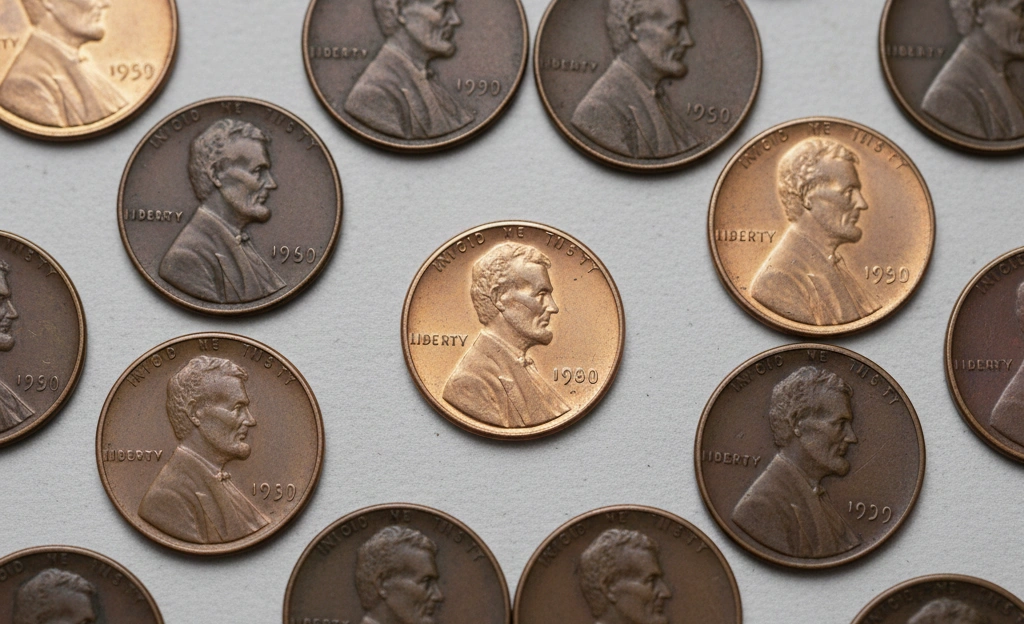
Investment interest remains limited exclusively to specimens graded MS67 and higher, along with specific minting defects.
Mint Facility | Mint Mark | Mintage |
Philadelphia | None | 7,387,420,000 |
Denver | D | 5,140,098,660 |
San Francisco (Proof) | S | 3,554,806 |
San Francisco (Uncirculated) | S | 27,284,200 |
Compositional Characteristics and Physical Parameters
Until 1982, the cent maintained fixed parameters later changed due to rising copper prices.
Material: 95% copper, 5% zinc.
Mass: 3.11 grams.
Diameter: 19.05 mm.
Thickness: 1.52 mm.
The metal value exceeding the face value forces many individuals to set aside these coins for melting, currently prohibited by US law.
Coin weight serves as a primary identifier when searching for "struck on a wrong planchet" errors.
Pricing Based on Condition Grading
The value of 1980 pennies demonstrates exponential growth transitioning from MS65 to MS67+ grades.
According to PCGS data, the number of certified specimens in the highest grades remains limited to a few units.
1980 Philadelphia Value
Grade | Approximate Price (USD) | Annual Change |
MS63 | $0.20 | +1% |
MS65 | $10 - $15 | +3% |
MS66 | $35 - $50 | +5% |
MS67 | $150 - $300 | +12% |
MS67+ | $2,500+ | +25% |
The record price for a 1980 cent without a mint mark reached $2,233 at Heritage Auctions in 2017 for a specimen graded MS67+ Red.
1980-D Value
Grade | Approximate Price (USD) | Annual Change |
MS63 | $0.25 | +1.5% |
MS65 | $12 | +2% |
MS66 | $45 | +4% |
MS67 | $450 | +15% |
MS67+ | $3,000+ | +30% |
Denver 1980 coins often exhibit production defects preventing the attainment of higher grades.
The record for a 1980-D MS67+ exceeds $3,200.
Classification of Color Designations (RD, RB, BN)
For copper coins, the letter designation for color critically affects the market valuation.
The evaluation depends on the visual preservation of the original luster.
Red (RD): The surface retains more than 95% of the original red luster.
Only such coins achieve record prices at auctions.Red-Brown (RB): Luster preservation ranging from 5% to 95%.
Value drops by 60-80% compared to the RD category.Brown (BN): Less than 5% of original luster.
Such specimens hold value only when possessing rare mint errors.
Rare Varieties and 1980 Mint Errors
Errors occurring during the manufacturing process create unique lots for auction trading.
This area contains the primary value for coins found in circulation.
1. Doubled Die (DDO)
Although 1980 does not possess "doubling" as prominently as 1955 or 1972, micro-varieties exist.
Doubling appears most frequently on the inscriptions "IN GOD WE TRUST" and the date — you can see it with the coin value checker app.
The price for a confirmed DDO in MS65 condition varies from $100 to $200.
2. Struck on a Dime Planchet
This represents one of the most expensive error types.
The coin features a smaller diameter, a silver color, and a weight of approximately 2.27 grams.
Inscriptions often appear clipped due to the insufficient surface area of the disc.
The value of such specimens at auction regularly exceeds $1,000.
3. Off-Center Strike
Image displacement occurs when the planchet fails to align fully within the striking zone.
10% off-center: value $5-$10.
50% off-center with preserved date: value $50-$150.
80-90% off-center: value decreases due to the loss of the mintage date.
4. Die Cracks (Cud)
Raised lines of metal forming during die wear are called "Cud."
Large metal accumulations near the edge of the coin are particularly valued.
A 1980 specimen featuring a major Cud effect is valued between $50 and $100.
Coin Inspection Process Prior to Sale
Locating a 1980 penny requires a sequential analysis.
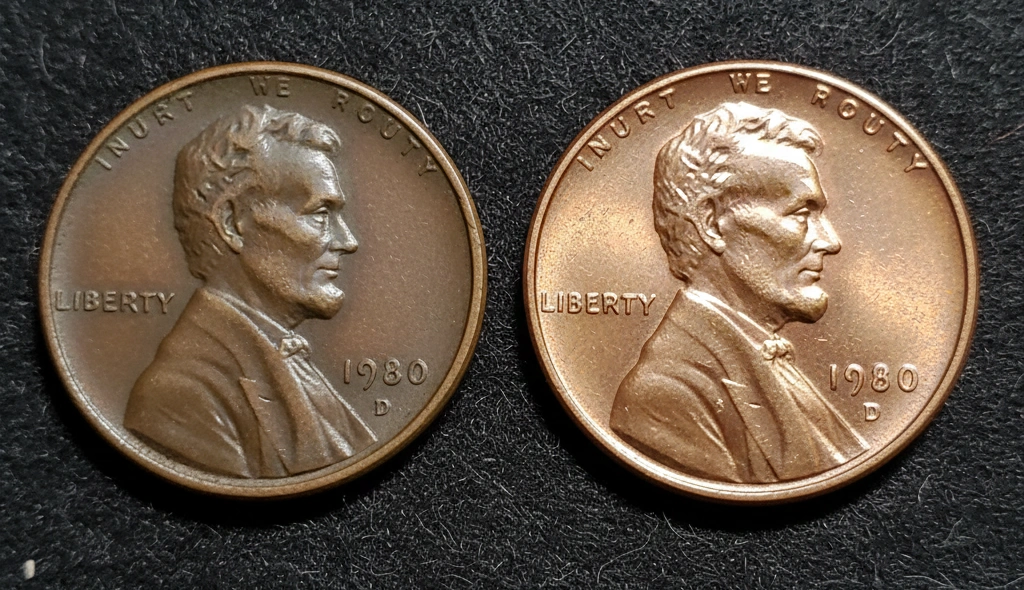
Weighing: Using scales with 0.01g precision allows for detecting counterfeits and identifying rare planchet types.
Color Assessment: Comparing surfaces against RD, RB, and BN standards.
Edge Verification: The 1980 cent must have a smooth edge; the presence of reeding indicates a counterfeit or the use of an incorrect planchet.
Or simply the coin identifier app.
Pricing Dynamics for Proof Coins
Proof quality coins were produced specifically for collectors' sets.
They feature mirrored fields and frosted relief.
1980-S PR69 Deep Cameo: value approximately $15-$20.
1980-S PR70 Deep Cameo: value reaching $500 and higher.
According to statistics over the last 10 years, the price for the PR70 grade increased by 40%, while PR69 remains stable due to high supply.
Value Depreciation
An investor purchasing 1980 coins must consider risks of price reduction.
Oxidation: The appearance of "carbon spots" on an RD coin surface reduces its category to RB, resulting in an immediate loss of 70% market value.
Cleaning: Any attempt at chemical or mechanical coin cleaning removes its numismatic value.
Professional grading companies (NGC/PCGS) apply a "Details" label, rendering the asset illiquid.Market Oversaturation: A sudden market entry of a 1980 MS67 hoard may reduce current prices for that grade by 15-20% within a year.
Key Indicators for a High-Value 1980 Coin
The following criteria are recommended for rapid identification:
Absence of any scratches visible to the naked eye.
Complete preservation of bright red copper luster.
Sharp definition of the Lincoln Memorial steps on the reverse.
Presence of visible image shifts or doubled letter outlines.
Weight differing from the 3.11g standard by more than 10%.